Showing posts with label archaeology. Show all posts

Friday, July 2, 2010

Monte Alto Culture: The Key to Understand Guatemala's Ancient History?

As we have learned in our journey, during a trip to Guatemala, the heart of Mesoamerica, visitors will discover a rich, sometimes violent, but always fascinating cultural history.
The cultural ancient history of Mesoamerica can be divided into three periods: The Pre-Classic from 2000 BC to 250 AD, (Early: 2000 BC to 800 BC, Middle: 800 to 400 BC, and Late 400 BC to 250 AD), Classic from 250 to 900 AD, (Early 250 to 550 AD, Middle from 550 to 700 AD and Late 700 to 900 AD), and Post Classic from 900 to 1500 AD, (Early 900 to 1200 AD, and Late 1200 to 1500 AD).
The first proof of human settlers in Guatemala dates at least as far back as 10,000 BC, although there is some evidence that put this date at 18,000 BC. The evidence includes obsidian arrowheads uncovered at various archeological sites.
The archaeological evidence concludes that early Guatemalan settlers were hunters and gatherers, but pollen samples from Peten and the Pacific coast indicate that corn cultivation was developed by 3,500 BC. The earliest Maya civilizations began to emerge in the highlands of Guatemala by as early as 2,000 BC.
By 2,500 BC, small settlements were developing in Guatemala’s Pacific lowlands, including such places as Tilapa, La Blanca, Ocós, El Mesak, and Ujuxte, where the oldest and beautifully designed ceramic pottery from Guatemala has been found. A heavy concentration of pottery on the Pacific coast has been documented dating from 2,000 BC.
Recent excavations suggest that the Highlands were a geographic and temporal bridge between Early Pre-classic villages of the Pacific coast and later Peten lowlands cities. There are at least 5,000 archaeological sites in Guatemala, 3,000 of them in Peten alone.
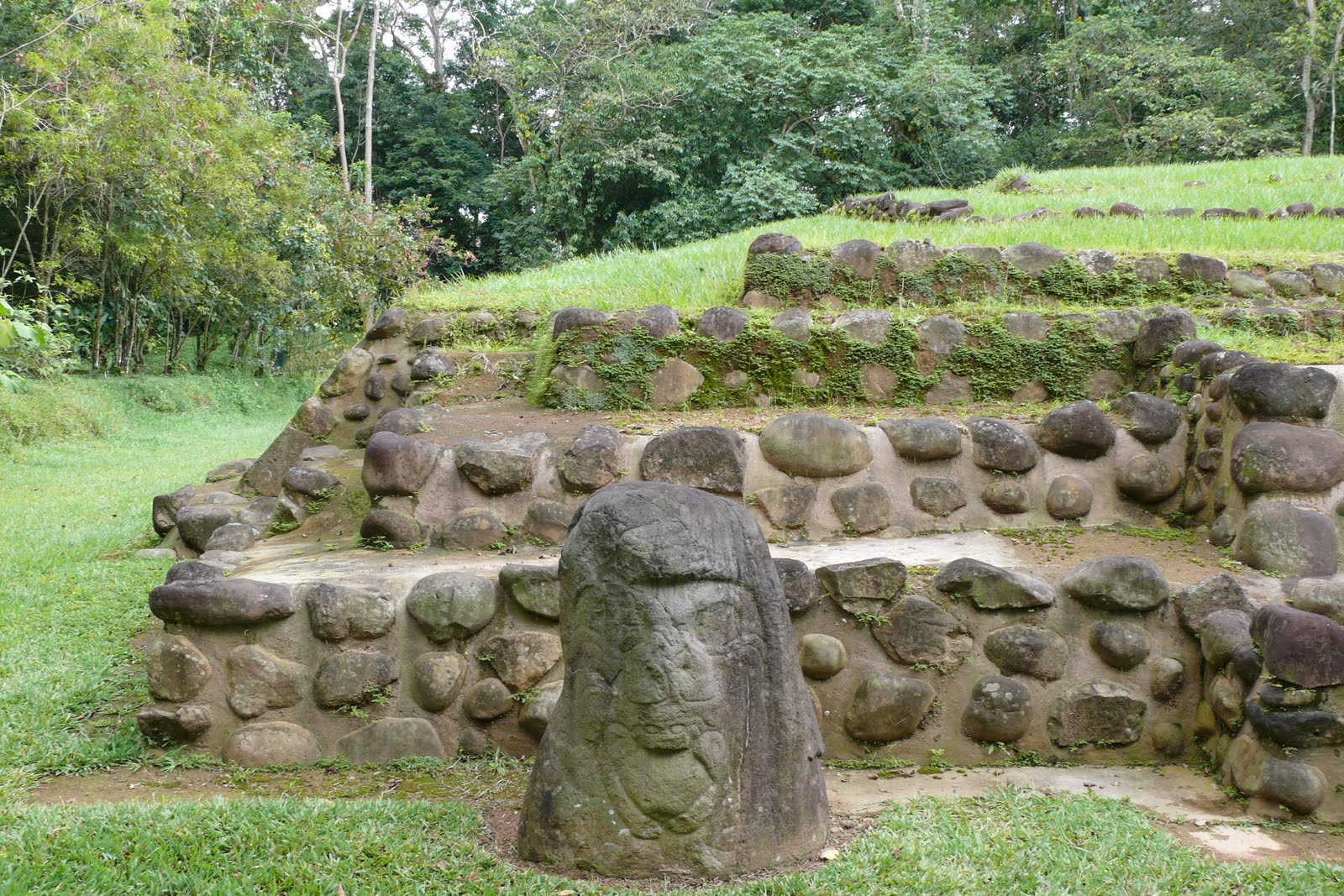
In Monte Alto near the municipality of La Democracia, Escuintla, giant stone heads and Potbellies (called Barrigones in Spanish) dating from 1800 BC, have been found. These are ascribed to the Pre-Olmec Monte Alto Culture, and some scholars suggest the Olmec Culture originated in this area of the Pacific Lowlands. However, it has also been argued that the only connection between these statues and the later Olmec heads is their size. Nonetheless, it is likely the Monte Alto Culture was the first complex culture of Mesoamerica, and predecessor of all other cultures of the region. In Guatemala, there are some sites with unmistakable Olmec style, such as Tak'alik Ab'aj, in Retalhuleu, which is the only ancient city in the Americas with both, Olmec and Mayan features.
Dr. Richard Hansen, the director of the archaeological project of El Mirador Basin in northern Peten, believes the Maya at that location developed the first true political state in America, (The Kan Kingdom), around 1,500 BC. Further, he disputes the common belief that the Olmec were the mother culture in Mesoamerica. Due to recent findings at El Mirador Basin, Hansen suggests  that the Olmec and Maya cultures developed separately, and then merged in some areas, such as Tak'alik Ab'aj on the Pacific Lowlands. There is no evidence yet to link the Pre-classic Maya from Peten and those from the Pacific coast, but Dr. Hansen believes they had cultural and economical links.
It is too bad that many questions will remain unanswered since countless pieces have been either destroyed or stolen throughout  the last centuries and there are many that, before protection laws were issued, were sent to foreign countries where they still are featured in museums.

Thursday, July 1, 2010

Santa Lucia Cotzumalguapa: Home to Ancient Civilizations

Santa Lucia Cotzumalguapa is an important archaeological zone of Guatemala, located in the department of Escuintla, at the foot of the Pacific volcanic range. Judging from current evidence, this area experienced an early development going back at least to the end of the Early Pre-Classic period (800 BC). By the Late Pre-Classic period, the region was the settlement for an important kingdom. The Stela 1 from El Baul has one of the earliest hieroglyphic inscriptions found in Meso-America, with the earliest legible date known in the modern territory of Guatemala, going back to the year 37 AC.
The region experienced an extraordinary development during the Late Classic period, between years 500 and 1000 AC. At this time, Santa Lucia Cotzumalguapa became one of the largest cities in Southern Meso-America, a major center of political power and cultural innovation.
Research has shown that the city covered approximately ten square kilometers, and included two major architectural compounds, which correspond to the sites known as El Baul and Bilbao.
Both are large platforms that sustain colossal compounds, and possess the major concentrations of monumental sculptures. A third important compound, known as El Castillo, also formed part of this urban center, and may have been the main plaza of this great city. A system of causeways and bridges joined together these three compounds with each other and with other sectors of the city.
The inhabitants of this area developed an original artistic style and a writing system of their own, which found expression in a large corpus of monumental sculptures. These include rock carvings, stone stelas, altars, gigantic heads, and three-dimensional sculptures, as well as a variety of architectural sculptures such as carved stairs, pillars and pavement stones.
There are also numerous portable sculptures. Characteristic of the Cotzumalguapa style is an extraordinary degree of realism in the representation of human figures, which in many cases may be considered as individual portraits, possibly representing kings and nobles. In many cases, these individuals appear participating in complex scenes, where they interact with other human characters or with supernatural beings. Sacrificial scenes are frequent.
Distinctive elements of the Cotzumalguapa style include speech scrolls shaped as vines with a variety of flowers and fruits. Hieroglyphic signs usually are inscribed in circular shapes, but they may also acquire complex animated forms.
Cotzumalguapa was most likely the seat of a powerful state, which exerted political control over a vast region of the Pacific coast. The diffusion of the sculptural style provides a measure of the geographic extension of Cotzumalguapa influence. The style is found along a 200 kilometer stretch of the Pacific coast, from the department of Suchitepequez to the modern border between Guatemala and El Salvador. It also had strong presence in some regions of the Central and Eastern Highlands, particularly in the region of what we know today as Antigua Guatemala. Some elements of the style are perceptible in sculptures from various sites located in Chimaltenango and along the Motagua river valley.

Tuesday, June 15, 2010

Tak'alik' Ab'aj: Archaeological and Natural Treasure

The millenarian history of Tak'alik Ab'aj is one of the most fascinating of Mesoamerica. The traces of the remarkable events that occurred at this site and how they affected the evolution of the cultures throughout the region have been found by the archaeologists in the remains of the materials, artifacts, monuments, and structures left by the early inhabitants: from massive monuments sculpted in stone, sacred buildings made of clay and faced with cobbles, ceramic vessels to stone and obsidian tools.
Even though only a very small portion (less than 10%) of the site has been excavated, the study of what has been found reflects the changes in styles and technology, and some of the skills and intellectual richness of the ancient architects and artisans. The observation of such changes has been determinant to establish the cultural, political, social, and economic development of these cultures.
The most ancient archaeological remains found at Tak'alik Ab'aj lead us 3,000 years into the past, around 1,000 BC, at the very end of the Early Pre-Classic Period. During this time, the inhabitants of Tak'alik Ab'aj built dwellings with cobblestone floors and thatched roofs supported by wooden posts. The pottery was hard-fired, black colored with a highly polished finish. The cutting tools they used were made of obsidian brought from the quarries of what we know today as San Martin Jilotepeque in the Department of Chimaltenango, and from El Chayal, located very close to the ancient city Kaminal Juyu.
The site, located in the municipality of El Asintal in the Department of Retalhuleu, is spread out over 6.5 squared kilometers along nine terraces. Its ceremonial center, at the city's core, is open to visitors but the remains of the city's outskirts are now on lands occupied by five coffee farms; one of these, on the ninth terrace, is home to an ecolodge.
Tak'alik Ab'aj is still an important ceremonial site and many Maya descendants from the Highlands perform ceremonies there.
To explore this place and learn about the civilizations that inhabited it, I invite you to come back tomorrow. I am sure we all will enjoy the visit!

Wednesday, January 27, 2010

What Places are we Going to Visit?

 
Let us start saying that Guatemala is divided into 22 departments and each one of these departments has its own capital. For our purposes, I decided to use the division as presented in the INGUAT (Guatemalan Institute of Tourism) official Website, which will guide us through 7 amazing regions:

1. Guatemala Modern and Colonial: Guatemala City and Antigua Guatemala. In terms of tourism, Guatemala City is probably the less visited destination in Guatemala while Antigua Guatemala is exactly the opposite. Despite the above statement about Guatemala City, I wait anxiously for the moment to describe it in detail, for now, I will just mention that within its limits is the ancient Maya city Kaminaljuyu, which dates back around 9,000 years and is one of America’s most notable archaeological sites. About Antigua Guatemala, one of the most beautiful places on earth, I have to say now that is one of the three Guatemalan places declared a World Heritage Site by Unesco.
2. The Living Maya Culture: Atitlan, Chichicastenango, Huehuetenango, Panajachel, Quetzaltenango, Tecpan, Totonicapán, Zunil. The whole region that we know as The Highlands is an area of extraordinary natural beauty and invaluable cultural richness where anyone can witness the Maya legacy and become part of a mystical experience.
3. The Ancient Maya World: Aguateca, Ceibal, Dos Pilas, Flores, Nakum, Rio Azul, Tikal Archaeological National Park, Yaxha, and Topoxte. In this region, we will appreciate the greatness and splendor of the Maya civilization. In 1979 Tikal, the largest excavated Maya city, and declared World Heritage Site by Unesco.
4. The Green Caribbean: Amatique Bay, Chocon Machacas Biotope (a nature reserve protected as one of the few remaining habitats for the endangered Caribbean Manatee), Lake Izabal, Livingston, Quirigua (another site declared World Heritage Site by Unesco), Rio Dulce. In this region we will find exuberant tropical nature surrounding Lake Izabal, which flows into Rio Dulce and then into the Caribbean Sea. This is the area where we will learn about the Garifuna culture, its music, and outstanding gastronomy.
5. The Natural Paradise of Las Verapaces: Candelaria Caves, Coban, Chilasco Waterfall, El Quetzal Biotope, Rabinal, Salama, San Jeronimo Valley, San Juan Chamelco, San Pedro Carcha, Tactic, and Semuc Champey. I will confess that this region is one of my favorites: it is house of the resplendent Quetzal –the national bird, some of the most impressive orchids including the rare Monja Blanca (Lycaste virginalis var. alba.), and several natural breathtaking monuments. In addition to that, the textiles are magnificent, the food is to die for, the coffee is outstanding, and the weather just gives you the perfect excuse to light up the chimney, pour a glass of wine, and enjoy either a good conversation or your favorite book.
6. The Exotic and Diverse Pacific Ocean: Monterrico (important for the sea turtle conservation), Pacaya Volcano National Park, Takalic Abaj and El Baul Archaeological Sites, and Xetulul and Xocomil Theme Parks. Guatemalans call this area The Coast. Bordering the Pacific Ocean and surrounded by impressive volcanoes, some of them active, beaches of volcanic sand, mangroves, and two important archaeological sites.
7. The Mystical and Natural East: Esquipulas Basilica, Ipala Volcano and Lagoon, Jalapa, Jocotan, and Jutiapa. This is a hot and seductive region, and one of the most impressive ecosystems one can imagine. I included a link in Jutiapa for personal reasons: it is not just my mother’s hometown, but also what gives me the White in my Maya-Mestizo-White origin.
Bookmark and Share