
Today's story is based on the field notes from photographer Kenneth Garrett while covering an important archaeology discovery in Tak'alik Ab'aj in 2004. The best, he said, "for the 20 years I've worked in the Maya world I've wanted to include Takalik Abaj in a story. Unfortunately, it never quite fit into what I was doing. But with the site representing a thousand years of Olmec and Maya civilization—the dawn of the Maya era—and [Guatemalan] archaeologist Christa Schieber de Lavarreda's discovery of one of the earliest Maya king's burials, we had all the elements in place to focus on the area."
Kenneth Garrett also said that the worst was when he left the place because "I knew we didn't have space to develop a bigger story, but the worst part was leaving before I could explore other things related to Takalik Abaj. It would have been good to stay longer and learn more about the trade routes into the highlands and along the Pacific. I would like to have learned how the Maya power centers moved into the lowlands, making Takalik Abaj less important after it had been a great commercial and religious center. But we wanted to keep the story focused on the site inside the protected national park.
Until now, the excavation continues and the archaeologists team continues to find amazing remnants of this equally amazing civilization.
So, with that being said, here are Mr. Garrett's notes and some of the wonderful images he captured during the process back in 2004.

Foreman Marvin Castillo beholds a freshly unearthed staircase at Takalik Abaj, an ancient Maya city in southwestern Guatemala, as excavator Pedro Gonzalez looks on. Stairways carried residents up and down the slopes at this urban center, built more than 2,000 years ago on ten natural terraces in the country's piedmont region. The city's early Maya phase ended about A.D. 200. "Takalik Abaj became important again long after its decline," says project co-leader Christa Schieber de Lavarreda. "People here continually remodeled buildings and relocated stone monuments sculpted in former times, a practice that continued until A.D. 1000. "

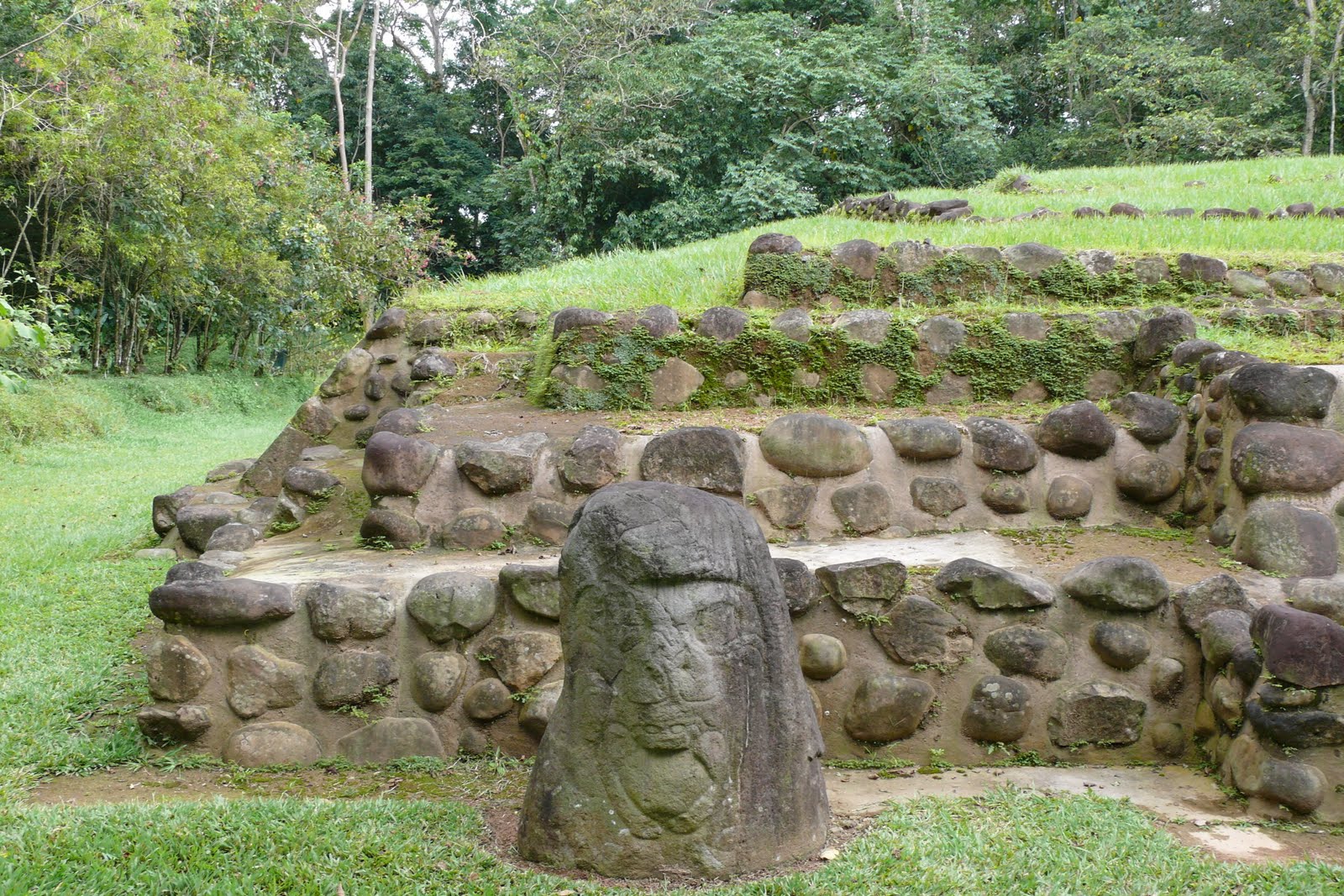
Centuries ago a Maya artisan carved a stela, or stone monument, with a highly stylized rendering of a serpent ascending from the water to the sky—a powerful image in Maya mythology. "The hallucinatory visions central to Maya ritual were symbolized visually by a rearing snake," wrote epigrapher Linda Schele. More than 270 monuments, largely from the Maya and earlier Olmec civilization, dot the landscape at Takalik Abaj, where a team recently discovered the unlooted grave of an early Maya king deep inside a ceremonial building.

Schieber stoops to drink from an aqueduct that delivers fresh water from the site's higher terraces to the north. Most of the building erected by the early Maya to sanctify the water system have disappeared, though the network of aqueducts still provides potable water to the nearby village of El Asintal. The project's team, led by archaeologists Schieber and Miguel Orrego Corzo, found this section in a small ravine obscured by a thick cover of subtropical vegetation and named the spot El Escondite, or "the hidden place."
The original article was published in National Geographic in May, 2004; if you are interested, there is an excerpt available in the magazine's Website.
Recommended reading:




 Posts


