Showing posts with label Retalhuleu. Show all posts

Friday, June 18, 2010

Champerico: A Picturesque Town on the Pacific Shores

Guatemala is not exactly known for its sandy, oceanside stretches. Void of ritzy, glamourous beaches where resorts and beach facilities hog the scene, Guatemala instead maintains coastal stretches that give visitors the real experience. 
When you think of it, that’s the beauty of a place like Champerico and some other beach areas nearby. Plenty of beaches around the world offer all kinds of amenities and fanfare, but sometimes it’s nice to find a place with more original character. Guatemala’s Pacific Coast is a relaxing place, ideal for escaping the cities and highlands for a bit.
In general, Guatemala's beaches are mostly about soaking up some rays and letting the crashing waves soothe your inner soul. Due to the volcanic nature of Guatemala, all the beach areas have dark sand, ranging in colors from brownish to black, which can heat up pretty quickly in the daytime sun.
From the beginning to the end, Guatemala's Pacific coast is almost a uniform long beach stretch, separated only for the mouth of the many rivers that end at the Pacific Ocean. Not a single bay! and that is why the tide is really strong with equally strong undertows, so wading out much farther than knee-deep is something everybody should consider twice, including the accomplished swimmers. On the other hand, being the beach quite wide, it is easy to enjoy long, languid walks.
So, as a beach destination, Guatemala might not be appealing for everybody, especially for those who think of the beach as white powder-like sand, blue crystal-clear water, and soft whispering-like waves...
Champerico and other beach-front villages nearby, are fishermen settlements, which means that we will enjoy fresh and delicious seafood, caught, cooked and served by locals, who after all, are the best part of our journey: kind, warm, smiley, eager to assist you in any way, making sure that your experience will be another memorable excursion.

Thursday, June 17, 2010

Reu: The Capital of the Department of Retalhuleu

Between diminutives, nicknames, similar names and even names that are exactly like others, remembering the names of the more than 300 municipalities throughout Guatemala is quite challenging-ish... In this case, Retalhuleu is the name of the Department and its capital city; to differentiate one from another, locals call Retalhuleu's capital: Reu. And to enter Reu we are going to pass through a nice long boulevard flanked by tall coconut palms that make us realize how close to the Pacific Ocean we are.
We could say that Reu is by far the most gorgeous city in the Southern Coast region. Urbanistically speaking, it was well planned and designed and locals are so proud of what they have accomplished, that their efforts can be appreciated almost wherever you go.
Reu and its people have that exuberant personality so typical in the tropical close-to-the-beaches towns: from good mood, joyful expressions, loud music, to a sense of laid-back attitude.
Since it is hot outside, I propose a visit to the Archeology and Ethnology Museum where we will admire many of the ancient and invaluable pieces recovered from the excavations in Tak'alik Ab'aj and the surroundings.
In addition to the historic treasures, in the second floor of this museum we will find an extraordinary collection of photographs that show the different development stages of Retalhuleu throughout the years.
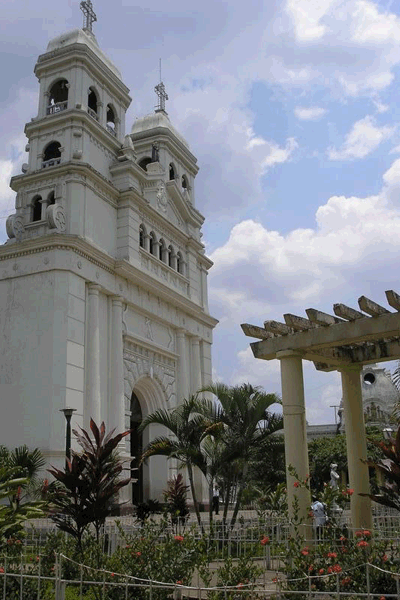
A visit to the Saint Anthony Church is worthy as well. The architecture is beautiful and even though the original retablo is not there anymore, the place is well preserved. The best part is that we can go upstairs to the bell tower from where we will contemplate magnificent views of the city and in the horizon, the Pacific Ocean.
At the end of the evening, when the sun is descending and the fresh coastal breeze can be felt, we will see how the streets seem to be busier and cheerful, as a prelude to our trip to the beach tomorrow...

Wednesday, June 16, 2010

Digging Into the Past: A Maya Royal Tomb

Today's story is based on the field notes from photographer Kenneth Garrett while covering an important archaeology discovery in Tak'alik Ab'aj in 2004. The best, he said, "for the 20 years I've worked in the Maya world I've wanted to include Takalik Abaj in a story. Unfortunately, it never quite fit into what I was doing. But with the site representing a thousand years of Olmec and Maya civilization—the dawn of the Maya era—and [Guatemalan] archaeologist Christa Schieber de Lavarreda's discovery of one of the earliest Maya king's burials, we had all the elements in place to focus on the area."
Kenneth Garrett also said that the worst was when he left the place because "I knew we didn't have space to develop a bigger story, but the worst part was leaving before I could explore other things related to Takalik Abaj. It would have been good to stay longer and learn more about the trade routes into the highlands and along the Pacific. I would like to have learned how the Maya power centers moved into the lowlands, making Takalik Abaj less important after it had been a great commercial and religious center. But we wanted to keep the story focused on the site inside the protected national park.
Until now, the excavation continues and the archaeologists team continues to find amazing remnants of this equally amazing civilization.
So, with that being said, here are Mr. Garrett's notes and some of the wonderful images he captured during the process back in 2004.
Foreman Marvin Castillo beholds a freshly unearthed staircase at Takalik Abaj, an ancient Maya city in southwestern Guatemala, as excavator Pedro Gonzalez looks on. Stairways carried residents up and down the slopes at this urban center, built more than 2,000 years ago on ten natural terraces in the country's piedmont region. The city's early Maya phase ended about A.D. 200. "Takalik Abaj became important again long after its decline," says project co-leader Christa Schieber de Lavarreda. "People here continually remodeled buildings and relocated stone monuments sculpted in former times, a practice that continued until A.D. 1000. "
Centuries ago a Maya artisan carved a stela, or stone monument, with a highly stylized rendering of a serpent ascending from the water to the sky—a powerful image in Maya mythology. "The hallucinatory visions central to Maya ritual were symbolized visually by a rearing snake," wrote epigrapher Linda Schele. More than 270 monuments, largely from the Maya and earlier Olmec civilization, dot the landscape at Takalik Abaj, where a team recently discovered the unlooted grave of an early Maya king deep inside a ceremonial building. 
Schieber stoops to drink from an aqueduct that delivers fresh water from the site's higher terraces to the north. Most of the building erected by the early Maya to sanctify the water system have disappeared, though the network of aqueducts still provides potable water to the nearby village of El Asintal. The project's team, led by archaeologists Schieber and Miguel Orrego Corzo, found this section in a small ravine obscured by a thick cover of subtropical vegetation and named the spot El Escondite, or "the hidden place."
The original article was published in National Geographic in May, 2004; if you are interested, there is an excerpt available in the magazine's Website.
Recommended reading:

Maya Archaeology 1: Featuring the Ancient Maya Murals of San Bartolo, Guatemala Chronicle of the Maya Kings and Queens, Second Edition (Chronicles)

Tuesday, June 15, 2010

Tak'alik' Ab'aj: Archaeological and Natural Treasure

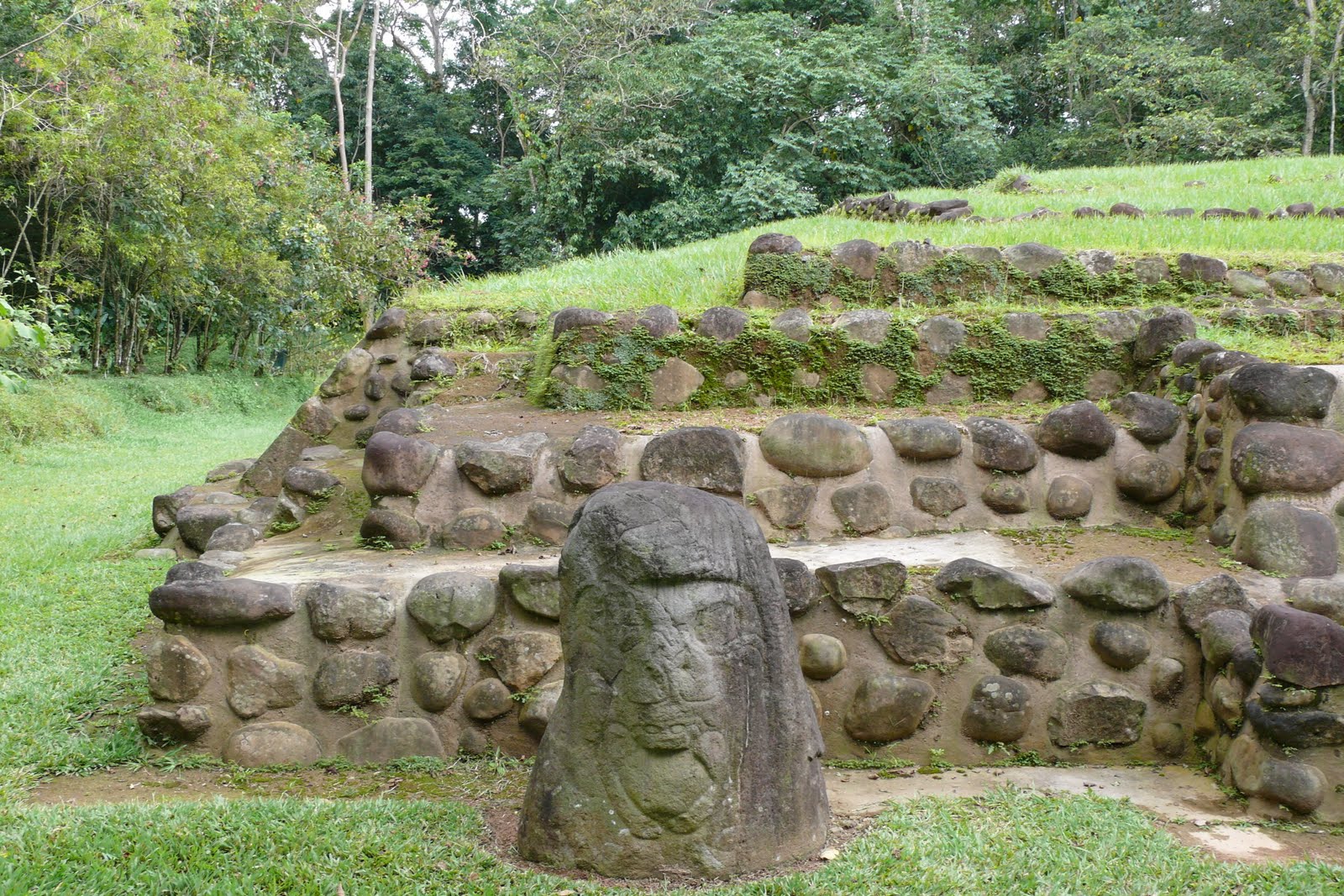
The millenarian history of Tak'alik Ab'aj is one of the most fascinating of Mesoamerica. The traces of the remarkable events that occurred at this site and how they affected the evolution of the cultures throughout the region have been found by the archaeologists in the remains of the materials, artifacts, monuments, and structures left by the early inhabitants: from massive monuments sculpted in stone, sacred buildings made of clay and faced with cobbles, ceramic vessels to stone and obsidian tools.
Even though only a very small portion (less than 10%) of the site has been excavated, the study of what has been found reflects the changes in styles and technology, and some of the skills and intellectual richness of the ancient architects and artisans. The observation of such changes has been determinant to establish the cultural, political, social, and economic development of these cultures.
The most ancient archaeological remains found at Tak'alik Ab'aj lead us 3,000 years into the past, around 1,000 BC, at the very end of the Early Pre-Classic Period. During this time, the inhabitants of Tak'alik Ab'aj built dwellings with cobblestone floors and thatched roofs supported by wooden posts. The pottery was hard-fired, black colored with a highly polished finish. The cutting tools they used were made of obsidian brought from the quarries of what we know today as San Martin Jilotepeque in the Department of Chimaltenango, and from El Chayal, located very close to the ancient city Kaminal Juyu.
The site, located in the municipality of El Asintal in the Department of Retalhuleu, is spread out over 6.5 squared kilometers along nine terraces. Its ceremonial center, at the city's core, is open to visitors but the remains of the city's outskirts are now on lands occupied by five coffee farms; one of these, on the ninth terrace, is home to an ecolodge.
Tak'alik Ab'aj is still an important ceremonial site and many Maya descendants from the Highlands perform ceremonies there.
To explore this place and learn about the civilizations that inhabited it, I invite you to come back tomorrow. I am sure we all will enjoy the visit!

Monday, June 14, 2010

Reserva Patrocinio: Let's Enjoy a Great One Day Tour!

Last week I was so anxious to restart the blog after our short break, that I skip the usual introduction to a new department. Well, after one week of traveling through Reu, which by the way is how locals call Retalhuleu, I am sure you might have an idea about this region, so I am just going to mention some details.
The name Retalhuleu comes from the K'iche voices Retal (sign), Hul (hole), and Uleu (earth), which translates as Sign on the Earth. The department is divided into 9 municipalities, and we already visited an area of Champerico when we went to the Manchon Guamuchal biological preserve, and San Francisco Zapotitlan, the municipality where the IRTRA parks and hotels complex is located.
Today, I want to guide you through Reserva Patrocinio, which even though it belongs to the department of Quetzaltenango, is easily accessible from Reu; actually from where we are right now, is only about 20 minutes. So please, join us today to discover another jewel of Guatemala's nature paradises.
This reserve covers an area of approximately 140 ha with a mosaic of different habitats, ranging in elevation from 750 to 850 meters above sea level. It is dedicated to the conservation of fragments of old growth broad-leaf forest, and to the restoration of the local natural habitat.
The conservation efforts as well as the school and medical clinic are sustained by the economical income generated by the agricultural crops (mainly coffee, cacao, rambutan, macadamia, and pacaya) and the tourism program.
Until now, 10 families live in the reserve whose members are involved not just in the tourism program as guides, room attendants, cooks and waiters, but also in the different tasks required for the agricultural project.
The Reserva Patrocinio is also a good site for easy bird watching. A network of trails and hanging bridges gives access to the forests and different plantations, where skilled birders can see more than 100 species on a good day during the migration season.
There is also an observation tower and feeding stations for fruit-eaters and hummingbirds, all of these are excellent spots to watch the birds. The list of recorded species in this place includes 185 species.
About 150 years ago, this area was covered with humid broad-leaf forest; unfortunately, human activity has shrunk the forest to fragments without biological corridors and that is why Scarlet Macaws and Red-throated Caracara, once common, are today extinct on the Guatemalan Pacific Slope.
Although these species did loose their appropriate habitat, the remaining forest fragments are important refuges for many other species.
This, among some others, is one of the reasons why I am convinced that the tourism industry and particularly sustainable tourism, may play a valuable role not just in the development of even the remotest communities, but also in the preservation of our natural richness.
To complement the wonderful nature experience, Reserva Patrocinio also offers wide trails for mountain biking and 4 cables for zip-lining where you can literally fly across the valley, over tropical vegetation and a coffee plantation.
And if all of the above is not enough, from the cafeteria at Reserva Patrocinio, which is only 9 kilometers away from the Santiaguito Volcano, we can admire impressive views of this amazing volcano. 
Did you enjoy our tour today?

Friday, June 11, 2010

Hostales del IRTRA: High Quality Lodging and Guatemalan Hospitality

Just across the road from the two theme parks Xocomil and Xetulul that we just visited, are Hostales del IRTRA, a beautiful and functional complex that encompass a virtual leisure city with various lodges, restaurants, bars, swimming pools, spa, and a mini-golf course. There are four separate lodging concepts ranging in price for visitors with no IRTRA ID, from $40 a night in a standard room for up two adults and two children to $300 a night for a luxurious suite.
The first hotel built within this complex is Hostal San Martin with 192 rooms, which was inspired by the Colonial architecture and resembles the Spanish government buildings of Antigua Guatemala. It consists of four separated buildings with long covered passageways with arches, and a spacious central plaza featuring a large fountain in the middle.
Hostal Santa Cruz was inspired by the Mediterranean-style architecture and offers 151 rooms elegantly decorated and distributed in 10 buildings.
Hostal La Rancheria consists of individual rustic yet comfortable and elegant cabanas designed for large parties. Every one of the 48 cabanas has 2 double bedrooms, 2 bathrooms, dining/living room, and fully equipped kitchenette.
Hostal Palajunol, the newest and most spectacular, was inspired by the cultures inhabiting the world’s tropical rain forests and has become the favorite. The buildings housing a total of 212 rooms at Palajunoj are worth a look for their unique architecture, since each one of the five buildings in this complex represents a different culture.
Nakuru - Africa
Papeete - Polinesia
Mandalay - Thailand
 Kalimantan - Indonesia
Uaxactun - Maya
At Hostales del IRTRA, all the rooms are equipped with private bathroom, cable TV and telephone. Air Conditioning is available in most of the accommodations, with the exception of the initial 92 rooms located on the first floor in the San Martin buildings that  have ceiling fans.
This beautiful hotel complex also offers a variety of leisure facilities, three splendid restaurants inside its premises, bars and snack bars, beautiful gardens and of course, complimentary transportation to the Xocomil and Xetulul theme parks.
Definitely, even though today is only a wishful thinking, I am ready to start packing!

Thursday, June 10, 2010

Xetulul: The Amusement and Cultural Park

The most recent theme park created by IRTRA, Xetulul, features 7 plazas (pavillions or squares) that represent a similar number of different cultures. Xetulul takes its name from a Mayan voice that translates as “under the trees”.
Three of the plazas are dedicated to Guatemala: the Plaza Chapina welcomes the visitors with replicas of historic buildings, such as the Railroad Station (the original in downtown Guatemala City, is now a beautiful museum), the Royal Palace (the original building was destroyed by an earthquake in 1917, and in its place we find the Centennial Park, which was built in 1921 to commemorate the first centennial of the Central America Independence), the Palace of the Noble Town Council (the original and well preserved in Antigua Guatemala still can be admired), and the Church at San Agustin Acasaguastlan (in the Department of El Progreso, still in our list to visit). Every building has an utilitarian purpose, such as restaurant, souvenirs shop, jewelry gallery, among others.
The Mayan Plaza features an impressive 112 feet-high recreation of the iconic Mayan temple Gran Jaguar (the original is in Tikal), painted in the colors archaeologists believe the original Mayan cities were decorated. The third plaza dedicated to Guatemala is the Guatemalan Town, which brings together several picturesque towns into one harmonic and charming plaza. Among other services and attractions, in this plaza we will find a seafood restaurant.
The Italy Pavilion features several buildings inspired in the Florentine and Venetian architecture, including recreations of the Ufizzi Gallery, the Palazzo Vecchio and a wonderful replica of the Fontana di Trevi. In addition to two Italian-style restaurants, in this area there is a Gelateria.
The France Pavilion includes recreations of the Moulin Rouge and the spectacular Grand Theater where magic shows are presented regularly. The Germany Pavilion is designed to look like a true German town and the Spain Pavilion features a replica of the Alhambra and houses with architecture from different regions of Spain. All the pavilions include several attractions, special services, and restaurants where food representative of the different countries is served.
But definitely the most exciting part of Xetulul are the rides and entertainment attractions. From thrilling roller coasters and chair-o-planes to bumper cars, carousels and screaming swings. You will certainly be able to experience an adrenaline rush if you’re up to the challenge. My inner child is already telling me, let's go! What about yours?

Wednesday, June 9, 2010

Xocomil: The Water Park

Honestly, I didn't think that an attraction like this could be of interest but to my surprise, I was wrong. Since the website I used as reference is in Spanish, a couple of our travel companions asked for details and I just can't say no. All the images I am posting today are from the IRTRA Website and I hope that they won't mind because I didn't have enough time to request them their authorization.
The park Xocomil takes its name from the Tz'utujil and K'aqchikel voice that translates as "strong wind blowing over the water", actually a phenomenon observed every day around 5 p.m. in the Lake Atitlan.
Xocomil is not only the biggest water-park of Guatemala, it’s also the most visited and complete. Designed around a Mayan pyramid, this fantastic 77,300 square meters amusement park features a full day of fun for the entire family.
The park features four different pools, two of them with waves, one for children and one for adults; one flowing river that provides a fun way to get around the park floating on a tube while passing through gigantic replicas of Mayan masks with waterfalls, water cannons, and a replica of a Mayan tomb.
Xocomil also includes seven options of water rides, which will thrill you to the core. From high speed slides in a 148 meters ride, five-people tubes riding through a series of curves and steep drops, floating rides through a dark tunnel that propels riders into a big funnel, to exhilarating vertical high speed rides, this park certainly has everything anyone can expect in a world-class water park.
So much fun couldn't be complete without something to eat, right? Well, while enjoying at the park, you will find at least six different snack bars and several ice cream stands, and in case you forgot your sun blocker lotion or need a swimming suit, don't worry, there are three shops inside the park where you can find almost everything you need, from disposable cameras to souvenirs.
The park opens regularly from Thursday to Sunday, from 9 am to 5 pm, and during certain holidays opens daily. The entrance fee for visitors with a valid IRTRA ID and up to 5 guests, is free of charge. For the rest of visitors, the entrance fees are (as of today's US currency exchange rate):  Adults, $12; Kids (up to 1.20m height), $6; Seniors (older than 60), $6. Isn't it great? I think it is, I am truly proud of this genuine Guatemalan accomplishment, as encourages me to think that projects like this somehow contributes to clear the misconception that some people may have about my motherland.
Bookmark and Share