Showing posts with label Santiago Atitlan. Show all posts

Wednesday, April 14, 2010

Santiago Atitlan: The Blooming of the Arts

Visiting the surroundings of Lake Atitlan, one cannot refrain from becoming enamored by the beautiful paintings representing the indigenous costumes and colorful landscapes that can be found in the numerous little art galleries, like the one above painted by one of the brothers Gonzalez Chavajay (from San Pedro La Laguna), which Marcelo and I bought a few years ago in Santiago Atitlan and now is the focal point in our dining room.
The blooming of the arts in Santiago Atitlan dates around 1950 when paintings by Juan Sisay started gaining fame in Europe and in the United States of America.
He died tragically in 1989; however, the second generation of Atitecos painters formed under Master Sisay's tutelage, emerged then. 
This second generation are two painters: 
Manuel Reanda who was the first assistant to Master Sisay, and Miguel Chavez who married one of Master Sisay's daughters and started working with him developing his own style, more modern and expressionist than primitivist.
The steps of this called second generation were soon followed by two of three Master Sisay's sons, Juan Diego and Juan Manuel who had both the opportunity to study in art schools in Guatemala City and Mexico.
Juan Diego and Juan Manuel were the first painters from Santiago to specialize almost exclusively in large portraits of the local citizenry, which appears to be the specialty of Santiago Atitlan artists.
As of today, there are several acknowledged Santiago Atitlan painters, among others, two grandsons of Master Sisay, Juan Diego and Juan Francisco, as well as Martin Ratzan and Pedro Reanda Petzey, who in addition to painting also does wood carving.
The Sisay family is one the most renowned of artistic families, adding rich history to the Guatemalan popular art. In the photo to the left, Juan Francisco Sisay and his art. To contact him, please send him an Email. Paintings to the right, on sale through Arte Maya.
The embroidery is also another expression of art in Santiago Atitlan and women have become true artists in this technique. In the photo above, Master Manuel Reanda and his wife Dolores Sapalu de Reanda, who wove and embroidered both attires.

Tuesday, April 13, 2010

Santiago Atitlan: Maximon and the Tz'utujil Religiousness

First, I am going to say that in general, Maya spirituality is an inclusive religion rather than exclusive. The Maya believe that the spirit of god/being/the creator is within everyone and within everything -mountains, water, air, fire, plants, and even rocks.
So, is Maximon religiousness or spirituality? To tell you the truth, I don't know; and, the more I asked, the more I read, the more I thought that I had learned, the more confused I got... so today, I am going to try to describe the way I saw an event that occurs once a year only in Santiago Atitlan.
This event takes place every Good Friday, it combines traditional Maya and Catholic rituals and confronts in public two longstanding traditions:  
On one side,  the annual penitents procession commemorates the crucifixion of Christ.
Very early in the morning, approximately 50 young male Atitecos (the gentilitious for the inhabitants of Santiago Atitlan) dressed in their finest traditional attires emerge from the town's 16th century cathedral carrying an immensely heavy wooden float on which rests the Holy Sepulcher containing the symbolic body of Christ.
For several hours,  they walk very slowly (3 steps forward and 2 steps backwards) through village streets  to visit the 4 points of the universe, which in Santiago Atitlan are represented by 4 small chapels.
The streets along the processional route, are decorated with vividly colored sawdust and flower petals in the form of long carpets with scenes of the life of Christ and other Catholic imagery. These ephemeral works of art are a collective neighborhood project often not completed until moments before the procession arrives.
On the other side, around 4 o'clock in the afternoon, when everybody seems to be tired and ready to go home, Maximon, who has been dressed and decorated for the occasion in a ritual that takes almost a week, makes his triumphal entrance carried on the shoulders of his Telinel, a special penitent chosen not only by his merits, but also for his physical strength. 
When both processions meet in the middle of the plaza, the Telinel carrying Maximon dances frantically, while several marimba ensembles play at once, hundreds of fireworks are litted up, and the spectators enjoy what it is considered the climax of the celebration and believe me, they celebrate big time!
Before finishing today's post, and as I promised yesterday, the story or legend around the name Maximon (he, who is tied), says:
The Ri Laj Mam was angry because due to the new religion, people started disrespecting their traditions and were forgetting to be thankful with mother earth and the Almighty, and to force them to again pay attention to everything that once had been important, he decided to cause very bad things throughout the town.
When the Shamanes (Maya priests, also known as Nahuales) understood what was going on, they broke the arms and legs of the statue to control its power  to some extent, and then they tied all the pieces together and covered his body with lots of clothes.

Monday, April 12, 2010

Santiago Atitlan: The Unfinished Conquest

I started this blog a few months ago, by mentioning that some times it is not easy to describe Guatemala; now that our journey brought us to Santiago Atitlan, I have to tell you that we are precisely in one of those places that make Guatemala so complex, yet rich in traditions and customs.
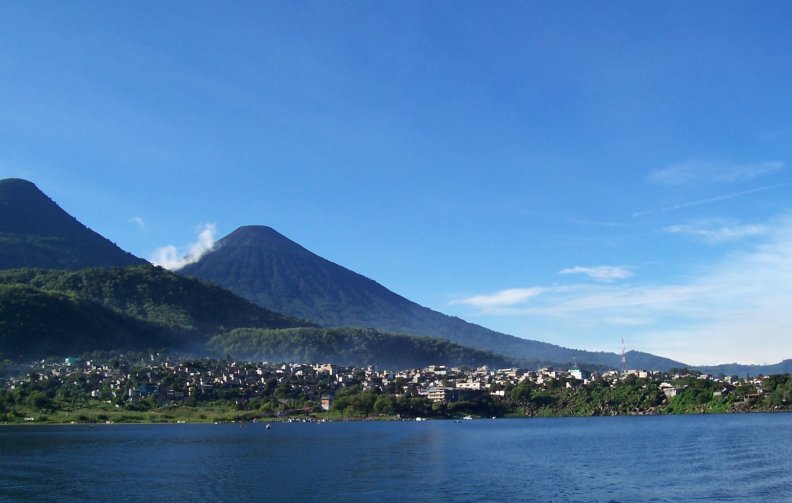
Let me start by elaborating a little bit about why I chose the above title for this posting, the unfinished conquest. The history of this town is quite long and it is said that this is due to the energy emanating from Lake Atitlan and the three volcanoes, which have attracted human beings since millennial civilizations.
Along the evolution of the area and its population, it is known that there were important settlements with different influences.  It is also known that the ancient governors were so powerful that the Tz'utujil territory covered a large geographic extension, from Lake Atitlan to the Pacific Ocean (through what we know today as the Departments of Suchitepequez and Retalhuleu).
During the colonial times the Tz'utujiles and the remains of their civilization, stayed in what we know today as Santiago Atitlan, a place where despite the Catholicism and recently other religion influences, the Mayan spirituality and religiousness prevail, probably, stronger than ever before and the major expression is the preservation of the annual cycle of rituals -where the traditional ceremonies are related with the planets alignment, designed to help them to maintain their own path and the celestial order.
Locals say that originally they accepted the protection of the Catholic church as the only resource they had to survive and even though they appeared to embrace the new religion, they managed to integrate the figure of Ri Laj Mam (the Tz'utujiles Grand Father) into the new cult. 
Some people say that the current name Maximon, is the indigenous pronunciation of San Simon; there are those who say that Maximon is a combination of Saint Peter, Judas Iscariot, and Pedro de Alvarado; some others say that actually "maximon" is a Tz'utujil voice that translates as "the one, who is tied", and of course, there is a story explaining the origin of such name, but that story my friends as well as the description of an important event that occurs every Good Friday only in Santiago Atitlan, will have to wait until tomorrow.
Bookmark and Share