Showing posts with label Lake Atitlan. Show all posts

Friday, April 16, 2010

Maya Heritage: The Textiles Around Lake Atitlan

From ancient times, probably for hundreds of centuries, the Mayan textiles have had not just an utilitarian purpose, but also have been artistic and cultural expressions to communicate different meanings. This visual literacy may become challenging since every symbol, every design, and the way every piece is worn, has a special meaning.
These hand-woven and hand-embroidered works of art in rainbow colors with geometric, floral, animal, and human designs, are quite impressive.
The traditional woman's dress includes a huipil (the blouse), a corte or falda (the skirt), a sash or faja (the belt), a cinta or the unique tocoyal from Santiago Atitlan (the adornment for the head or hair), a perraje or rebozo (the shawl), and different multipurpose accesories, called tzute (a head-cloth), servilleta, yagual, among others.
Men on their side, wear camisa (shirt) and pantalon (trouser), and only the most traditional still wear rodillera (a short woolen kilt), gaban (a black woolen over-garment), morral (shoulder woolen bag), and tzute. Some may wear sombrero (hat) on top of the tzute or only the hat.
Also from ancient times, loomers are always eager to learn about new materials and techniques, a reason why innovation and change in design, colors combination, and dress styles are inevitable and very exciting.
If you would like to learn about this beautiful tradition, I would like to recommend a couple of books and of course, the extraordinary Ixchel Museum in Guatemala City.

Maya of Guatemala, Life and Dress
Carmen Pettersen 
The classic survey of Guatemalan Maya dress, first published in 1975. Includes 60 watercolor illustrations and 26 photographs.


Sown Symbols
Barbara de Arathon
A study of the symbols woven into the traditional Maya textiles and their importance. Includes the tree of life, the center of the village, the turkey the vertical and horizontal rows, the ceremonial plate, the double eagle, the star, and the serpent.

Thursday, April 15, 2010

Lake Atitlan: The Apostles and the Lakeside Villages of La Laguna

After visiting Santiago Atitlan and admiring this stunning sunrise, we will continue our journey around Lake Atitlan, where we will find several small towns most of them called La Laguna, in this order: San Pedro La Laguna, San Juan La Laguna, Santa Clara La Laguna, San Pablo La Laguna, Santa Cruz La Laguna, and San Jorge La Laguna.
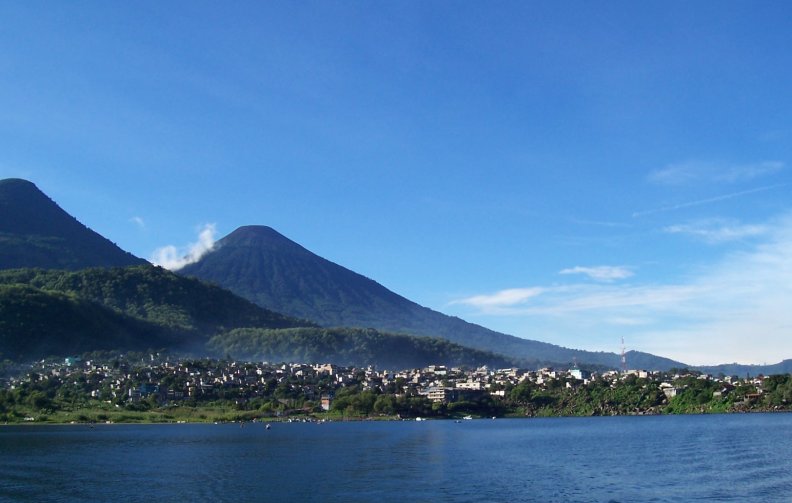
View to San Pedro (on the slopes of the volcano) and San Juan La Laguna.
Close to Santa Clara La Laguna, in the inland, we can visit Santa Maria Visitacion and San Andres Sajcabaja. 
View to the Sierra Panimaquin. 
Also in the inland but not so close to the lake, are the rest of municipalities of the Solola Department: Santa Lucia Utatlan, San Juan Cotzal, Santa Catarina Ixtahuacan, and further away, Nahuala, a place that despite its relative isolation has developed an important rustic furniture and wooden carvings industry, spread all over Central America.
Mural in San Juan La Laguna.
In as much as I would love to stop in each one of these little towns, I am afraid it would probably turn out too repetitive since they are very similar in customs, artistic contribution, traditions, rituals and ceremonies, and definitely, the landscape dominated by the beautiful lake and the majestic volcanoes.
Cofradia in San Jorge La Laguna.
So today, instead of sharing history fragments, stories and anecdotes, not even cooking recipes, I decided to share with you marvelous images.
Cayucos on the shore.
This is why I am in love with my Guatemala!
 The Sunset.

Monday, April 12, 2010

Santiago Atitlan: The Unfinished Conquest

I started this blog a few months ago, by mentioning that some times it is not easy to describe Guatemala; now that our journey brought us to Santiago Atitlan, I have to tell you that we are precisely in one of those places that make Guatemala so complex, yet rich in traditions and customs.
Let me start by elaborating a little bit about why I chose the above title for this posting, the unfinished conquest. The history of this town is quite long and it is said that this is due to the energy emanating from Lake Atitlan and the three volcanoes, which have attracted human beings since millennial civilizations.
Along the evolution of the area and its population, it is known that there were important settlements with different influences.  It is also known that the ancient governors were so powerful that the Tz'utujil territory covered a large geographic extension, from Lake Atitlan to the Pacific Ocean (through what we know today as the Departments of Suchitepequez and Retalhuleu).
During the colonial times the Tz'utujiles and the remains of their civilization, stayed in what we know today as Santiago Atitlan, a place where despite the Catholicism and recently other religion influences, the Mayan spirituality and religiousness prevail, probably, stronger than ever before and the major expression is the preservation of the annual cycle of rituals -where the traditional ceremonies are related with the planets alignment, designed to help them to maintain their own path and the celestial order.
Locals say that originally they accepted the protection of the Catholic church as the only resource they had to survive and even though they appeared to embrace the new religion, they managed to integrate the figure of Ri Laj Mam (the Tz'utujiles Grand Father) into the new cult. 
Some people say that the current name Maximon, is the indigenous pronunciation of San Simon; there are those who say that Maximon is a combination of Saint Peter, Judas Iscariot, and Pedro de Alvarado; some others say that actually "maximon" is a Tz'utujil voice that translates as "the one, who is tied", and of course, there is a story explaining the origin of such name, but that story my friends as well as the description of an important event that occurs every Good Friday only in Santiago Atitlan, will have to wait until tomorrow.

Friday, April 9, 2010

San Lucas Toliman: Modern and Progressive

This is one of the largest, modern, and progressive municipalities of the Solola Department, whose indigenous name, Toliman, is a derivative of the word Tule, for the tule reeds that grow abundantly in the area and constitutes one important component of the town's economy.
From the total population of around 25,000 inhabitants, the gender distribution is quite equitable: 51% are women and 49% men; however, the average age is quite unexplainable: almost 60% are younger than 25 years old, while only 3% are older than 60 years old. Speaking about statistics, I think it is good to mention that the schooling rate in San Lucas Toliman appears to be 83%, slightly above the 82%, which is the national average.
Somehow, I think this high schooling rate is related with the Educational Program Utzilal Tijonikel (which translated from the Kaqchikel language means Educating for Good), a program that is part of the Fundacion Rigoberta Menchu, as well as the San Lucas Mission, which is involved in development and educational programs.
As for the predominant ethnic group, most of the population are  Kaqchikeles descendants; however, the Tz'utuhiles influence  is notorious because their language is a combination of both: Kaqchikel and Tz'utuhil.
The main economic activities in San Lucas Toliman are agriculture-related, being the coffee production and processing one of the strongest.
In addition, they are good manufacturers of utilitarian products, such as quarry metates with manos (the two volcanic stone-pieces that Mayas have used from ancient times to grind and mash) and molcajetes (a mortar-like utensil made with volcanic stone that Mayas have used to grind and crush), tule basketry and mats, candles, and wooden artifacts.
 
Due to San Lucas Toliman geographical location, the surroundings, including the nature reserve in the Iq'itiw Hill, are a great place for hiking and nature exploration.
This area is home to several endangered and protected species such as jaguars, pumas, white-tail deers, armadillos, green toucans, among others.

Thursday, April 8, 2010

San Antonio Palopo: An Oasis of Peace

San Antonio shares the Kaqchikel part of its name, Palopo, with its neighbor, Santa Catarina Palopo which we visited yesterday; because as I said, this was a region where amate trees, like the one we can see at the end of the terraces, were abundant long time ago.
The town is one of the most traditional Mayan villages in the area and if you are really interested in the local culture, I would recommend to explore the place at your own pace.
Don't miss the church in the center of the town, the archaeological site Choka-kay, the nature reserve in Tzampetey, and the Maya Altar Sacsiguan. It  will be a rewarding experience!
Until 1980, when the road was completed, the only way to go to San Antonio Palopo was either by boat or walking and I am sure that because of this recently disrupted isolation, people here are more traditional and the whole town allows you to experience a special quietness and peace state, conducive to enjoy the breathtaking views.
One of the remarkable features of the industrious "Tunecos" as locals call themselves, is that they have organized a cooperative to standardize, collect, and commercialize the  lead-free mayolica-style pottery and textile production of the local weavers and they are exporting this production directly to Germany, Italy, England, and the United States of America. 
Among the articles they produce, we can find shawls, napkins, place mats, and belts in a wide range of colors, all of them weaved in the traditional back-strap and treadle-loomers.

Tuesday, April 6, 2010

Panajachel: The Gateway to Lake Atitlan

Speaking of Panajachel is to speak about the Atitlan Lake, a large endorheic lake (one that does not flow to the sea), which according to some writers, including Antoine de Saint-Exupery, who lived in Guatemala in 1937 and is author of Le Petit Prince, is amongst those classified as the most beautiful lakes in the world.
On the road from Solola to Panajachel we are going to see the Tz'ala Waterfall and it is common for the traffic to be slow in the area because people like to stop to take photos and to be photographed with that beautiful background.

Panajachel is packed with hotels, restaurants, art galleries, Spanish schools and dozens of souvenirs shops along the Santander street and on the shores of the lake.
It is a place where people from all over the world have become to settle down and have transformed the town into an eclectic community.
Although it has several places interesting enough to be visited, Panajachel per se, has become the center for the tourist trade of the area as it provides a base for visitors crossing the lake to visit other towns and villages. If you decide to explore the place, let me tell you that you will certainly find it interesting, diverse, colorful, even educational.
Thus, the star of the picture is the lake, whose name is a Tz'utujil voice that translates as "the place where the rainbow gets its colors".
 

In Guatemala's highlands, especially around Lake Atitlan, the Maya culture still rules. The spirit it invokes is the hidden gem of Guatemala, and makes this one of the most exotic destinations in the world, just as we are about to discover during the next days on board of one of these boats.
Photos by galasdeguatemala.com, used with authorization.
And last but not least, I want to share with you this map to give you an idea about the tour we are going to take in and around the lake.

View Lake Atitlan in a larger map.
Bookmark and Share