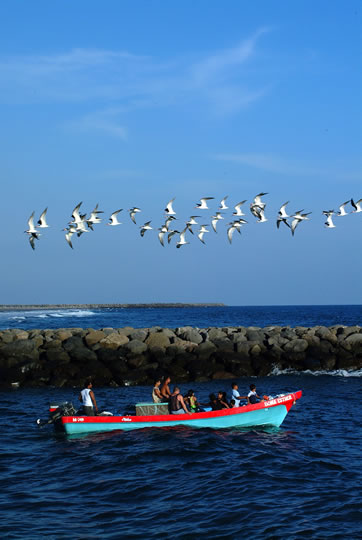
Showing posts with label Escuintla. Show all posts

Tuesday, July 6, 2010

Passing by Guatemala on a Cruise: Puerto Quetzal

Puerto Quetzal is Guatemala's largest Pacific Ocean port and it is important for both, cargo traffic and as a stop-off point for cruise liners. And to those passing by Guatemala on board a cruise, let me tell that sometimes our eyes limit what we see. In the case of Puerto Quetzal this might be the situation.
Standing on the railing of a cruise ship looking out over the landscape beyond the port, leaves someone with the feeling that it's time to save our money for an excursion in another port. And for the most part that's what everyone does. That is a shame because you will be missing out on "what's over the next hill". And over the next hill is an erupting volcano, a 400 year old city, beautiful architecture, scenery, gardens and ancient ruins of civilizations long gone.
All that is required to see all of this is a sense of adventure and losing that expectation that you have from your own home town. Taking that step on the gangway to move forward, to venture out, to lose oneself in another country and culture. To experience someplace other than where you live. So open the box and be surprised. You may like it.
There are several options to choose from, but to give you an idea I selected a day tour to one of my favorite places in the country, Antigua Guatemala, the colonial capital, so let me describe how it could be.
By tour bus it's an hour and a half scenic drive by coffee plantations, sugar cane fields and rising volcanoes. This charming town, located 4,500 feet above sea level, is also a UNESCO World Heritage site famous for both its colorful Spanish Mudejar-influenced Baroque architecture and its many ruins of colonial churches. While relaxing around Antigua's popular Parque Central, visitors are afforded a view of many notable architectural landmarks as well as the spectacular natural beauty of the three major volcanoes that tower over the city's low skyline.
Just up the street from the park, a short 10 minute walk is the next place you don't want to miss, Casa Santo Domingo. Once a convent devoted to the followers of the Grand Order of Santo Domingo de Guzman, its now a beautiful hotel set among the ruins. Beautiful arches covered in flowering vines, gardens that surround fountains of cool water greet you as you move around the property. Make sure you have plenty of space on your digital camera. It's absolutely beautiful. You may even want to come back for an extended stay.
Until now, you've been walking for a bit and it's probably time for a break. Head down to the Jade factory, which is located just a few minutes walk from Casa Santo Domingo. The factory is kind of your welcome and departure center for Antigua when visiting the city from a cruise. A great staff  is ready to greet you as you get off the bus and the factory is always in full swing to watch the fine craftsmanship of all the pieces. Buses will let you off and pick you up here.
By  now you've finished your tour of Antigua Guatemala and have headed back to the ship. I hope you enjoyed yourself and experienced the beauty and culture of this part of Guatemala. 

Friday, July 2, 2010

Monte Alto Culture: The Key to Understand Guatemala's Ancient History?

As we have learned in our journey, during a trip to Guatemala, the heart of Mesoamerica, visitors will discover a rich, sometimes violent, but always fascinating cultural history.
The cultural ancient history of Mesoamerica can be divided into three periods: The Pre-Classic from 2000 BC to 250 AD, (Early: 2000 BC to 800 BC, Middle: 800 to 400 BC, and Late 400 BC to 250 AD), Classic from 250 to 900 AD, (Early 250 to 550 AD, Middle from 550 to 700 AD and Late 700 to 900 AD), and Post Classic from 900 to 1500 AD, (Early 900 to 1200 AD, and Late 1200 to 1500 AD).
The first proof of human settlers in Guatemala dates at least as far back as 10,000 BC, although there is some evidence that put this date at 18,000 BC. The evidence includes obsidian arrowheads uncovered at various archeological sites.
The archaeological evidence concludes that early Guatemalan settlers were hunters and gatherers, but pollen samples from Peten and the Pacific coast indicate that corn cultivation was developed by 3,500 BC. The earliest Maya civilizations began to emerge in the highlands of Guatemala by as early as 2,000 BC.
By 2,500 BC, small settlements were developing in Guatemala’s Pacific lowlands, including such places as Tilapa, La Blanca, Ocós, El Mesak, and Ujuxte, where the oldest and beautifully designed ceramic pottery from Guatemala has been found. A heavy concentration of pottery on the Pacific coast has been documented dating from 2,000 BC.
Recent excavations suggest that the Highlands were a geographic and temporal bridge between Early Pre-classic villages of the Pacific coast and later Peten lowlands cities. There are at least 5,000 archaeological sites in Guatemala, 3,000 of them in Peten alone.
In Monte Alto near the municipality of La Democracia, Escuintla, giant stone heads and Potbellies (called Barrigones in Spanish) dating from 1800 BC, have been found. These are ascribed to the Pre-Olmec Monte Alto Culture, and some scholars suggest the Olmec Culture originated in this area of the Pacific Lowlands. However, it has also been argued that the only connection between these statues and the later Olmec heads is their size. Nonetheless, it is likely the Monte Alto Culture was the first complex culture of Mesoamerica, and predecessor of all other cultures of the region. In Guatemala, there are some sites with unmistakable Olmec style, such as Tak'alik Ab'aj, in Retalhuleu, which is the only ancient city in the Americas with both, Olmec and Mayan features.
Dr. Richard Hansen, the director of the archaeological project of El Mirador Basin in northern Peten, believes the Maya at that location developed the first true political state in America, (The Kan Kingdom), around 1,500 BC. Further, he disputes the common belief that the Olmec were the mother culture in Mesoamerica. Due to recent findings at El Mirador Basin, Hansen suggests  that the Olmec and Maya cultures developed separately, and then merged in some areas, such as Tak'alik Ab'aj on the Pacific Lowlands. There is no evidence yet to link the Pre-classic Maya from Peten and those from the Pacific coast, but Dr. Hansen believes they had cultural and economical links.
It is too bad that many questions will remain unanswered since countless pieces have been either destroyed or stolen throughout  the last centuries and there are many that, before protection laws were issued, were sent to foreign countries where they still are featured in museums.

Thursday, July 1, 2010

Santa Lucia Cotzumalguapa: Home to Ancient Civilizations

Santa Lucia Cotzumalguapa is an important archaeological zone of Guatemala, located in the department of Escuintla, at the foot of the Pacific volcanic range. Judging from current evidence, this area experienced an early development going back at least to the end of the Early Pre-Classic period (800 BC). By the Late Pre-Classic period, the region was the settlement for an important kingdom. The Stela 1 from El Baul has one of the earliest hieroglyphic inscriptions found in Meso-America, with the earliest legible date known in the modern territory of Guatemala, going back to the year 37 AC.
The region experienced an extraordinary development during the Late Classic period, between years 500 and 1000 AC. At this time, Santa Lucia Cotzumalguapa became one of the largest cities in Southern Meso-America, a major center of political power and cultural innovation.
Research has shown that the city covered approximately ten square kilometers, and included two major architectural compounds, which correspond to the sites known as El Baul and Bilbao.
Both are large platforms that sustain colossal compounds, and possess the major concentrations of monumental sculptures. A third important compound, known as El Castillo, also formed part of this urban center, and may have been the main plaza of this great city. A system of causeways and bridges joined together these three compounds with each other and with other sectors of the city.
The inhabitants of this area developed an original artistic style and a writing system of their own, which found expression in a large corpus of monumental sculptures. These include rock carvings, stone stelas, altars, gigantic heads, and three-dimensional sculptures, as well as a variety of architectural sculptures such as carved stairs, pillars and pavement stones.
There are also numerous portable sculptures. Characteristic of the Cotzumalguapa style is an extraordinary degree of realism in the representation of human figures, which in many cases may be considered as individual portraits, possibly representing kings and nobles. In many cases, these individuals appear participating in complex scenes, where they interact with other human characters or with supernatural beings. Sacrificial scenes are frequent.
Distinctive elements of the Cotzumalguapa style include speech scrolls shaped as vines with a variety of flowers and fruits. Hieroglyphic signs usually are inscribed in circular shapes, but they may also acquire complex animated forms.
Cotzumalguapa was most likely the seat of a powerful state, which exerted political control over a vast region of the Pacific coast. The diffusion of the sculptural style provides a measure of the geographic extension of Cotzumalguapa influence. The style is found along a 200 kilometer stretch of the Pacific coast, from the department of Suchitepequez to the modern border between Guatemala and El Salvador. It also had strong presence in some regions of the Central and Eastern Highlands, particularly in the region of what we know today as Antigua Guatemala. Some elements of the style are perceptible in sculptures from various sites located in Chimaltenango and along the Motagua river valley.

Wednesday, June 30, 2010

San Vicente Pacaya and the Volcano

Due to the tragic incidents occurred just a month ago,  I had to think more than twice about including the San Vicente Pacaya municipality in today's post. To be honest, after the tremendous explosion of the Pacaya Volcano and just a couple of days after that, the flooding caused by the heavy rains poured during the Agatha Storm over the central valley still covered with a thick layer of volcanic residues, made me wonder if I should just skip talking about the Pacaya area. Not knowing how damaged is the town, the villages nearby, and the surrounding natural attractions, including the Caldera Lagoon, made me feel unconfortable about today's post. Not withstanding my reservations and overcoming my hesitation, I decided to feature Pacaya.
I wouldn't like to seem disrespectful and sincerely hope that everything is returning to normal for the people in the area, my best wishes are with them for speedy recovery.
This recovery brings me back to  the possibilities that many of Guatemala's regions could benefit from tourism. I will keep stating that tourism is a great way to improve everybody's lives: while travelers enjoy and learn, locals promote and sell their products or services.
Even after last month's explosion, the Pacaya Volcano National Park continues to be  the municipality's main tourist attraction. The volcano is actually a complex of several active volcanoes, only 30 kilometers east of Guatemala City.
For years, it has been a popular volcano to climb because I know for a fact that it wasn't too difficult and, on sunny days, the views are stunning. Again, I don't know the current conditions and am not even sure that the park is open for climbing excursions.
The Pacaya volcano is  part of the Central American Volcanic Arc, a chain of volcanoes stretching from the northwest to the southeast along the Pacific coast of Central America, formed by the Cocos Tectonic Plate beneath the Caribbean Plate. The volcano lies on the southern edge of a sizable volcanic caldera formed in the Pleistocene age which contains Lago de Amatitlan.
After the last caldera-forming eruption 23,000 years ago, several smaller vents within and around the caldera have seen eruptive activity. Pacaya is the largest post-caldera volcano, and has been one of Central America's most active volcanoes over the last 500 years.
About 1,100 years ago, the volcano's edifice collapsed, causing a huge landslide. Deposits from the landslide traveled about 25 kilometers (16 mi) from the volcano down to the Pacific coastal plain. The landslide left a large crater, within which the current active cone has grown. The presence of a magma chamber at shallow depths beneath the volcano means that distortion of the cone leading to instability and future landslides remains a hazard to the surrounding areas and considering  what happened a month ago, it would be expected that those towns are relocated to safer areas, after all, there is nothing we can do against the forces of nature.

Tuesday, June 29, 2010

Pa'laq ja' -The Standing Water-

Pa'laq ja' is the land of the Maya Poqomam descendants and remains as one of the few municipalities in the lowlands where ancient traditions are still observed, and the only one in Escuintla where women wear the typical costume. This is Palin.
The name in Poqomam that translates as "standing water", is a reference of the town's location: right on the slopes of the Agua Volcano. The current name, Palin, is a Nahuatl-origin voice that translates as "place of strong winds" and is a reference of the windy phenomenon that occurs from November to February.
The area is surrounded by intense volcanic activity, so there are several places with thermal and sulfurous springs and swimming pools.
One of the main features of Palin that I remember the most, is the enormous Ceiba Pentandra tree (Guatemala's national tree) in the center of the central plaza, which according to the records, was planted during the founding of the town on July 30, 1535.
Before the new toll highway was built, Palin was a stop in the route to El Puerto (the beach). That stop had the purpose to buy fresh produce and fruits whose aromas seemed to be floating under the ceiba shade. Right now, I am thinking of the big, almost flat baskets full of anacates  displayed over bright green banana leaves (anacates are yellow umbrella-like mushrooms, related to the better known chanterelles)... What a treat! A chunky and simple anacates sauce poured over a tenderloin steak is like heaven.
Since the opening of the toll highway, Palin is no longer a regular stop for people going to El Puerto and the market is no longer open-air under the ceiba; even though, Palin continues to be an interesting place to visit.

Monday, June 28, 2010

Escuintla: Guatemalan Lowlands Heart

Welcome to a new department in the lowlands: Escuintla. A name that brings me joyful memories from times spent with my family and friends. A name that always makes me think of that candid image of the Resplendent Quetzal painted over the rocks on the road somewhere close to Palin, one of  Escuintla's municipalities, which has been there since I can remember...
The innumerable rivers crossing this department contribute to the fertility of its soils; and the beautiful mangroves bordering its coast, have been declared an ecological reserve zone. It is one of the most active tourist sites in the country and a favorite for city dwellers many of whom own  beach-side vacation villas.
Its current economic prosperity comes from the exploitation of large extensions of land in the cultivation of sugar cane and livestock ranches. The modern Puerto Quetzal and its intense activity also contributes to the prosperity of this Department.
On average, the altitude in Escuintla is 350 meters above sea level and it bounds to the north with the departments of Chimaltenango, Sacatepequez, and Guatemala; to the east with Santa Rosa; to the west with Suchitepequez; and to the south with the Pacific Ocean. This department is divided into 13 municipalities, and its capital is also named Escuintla.
The slopes of the Volcanic Chain are humid and the moist clouds provide a constant rain that makes the area a true tropical rain forest,  home to  micos (Callitrichidae -synonym Hapalidae- also known as New World monkeys), ocelots, weasels, and other species.
The extensive seashore is composed of gray sands of  volcanic origin, interrupted  only by the mangrove forests and channels which provide an excellent habitat to fiddler crabs, pelicans, seagulls, beach scavengers, and robust stolon grasses..
Other interesting attractions in this area are: the Guacalate River Canyon, the Pacaya Volcano, the caverns and waterfalls of San Pedro Martir, and the archaeological sites El Baul, Bilbao, and El Castillo.
The well maintained  road network makes traveling through and across  Escuintla  very easy.  Some of the most important roads are: Hwy  CA-9 (the Inter Oceanic Road from south to north) and  Hwy CA-2 (the Pacific Road from west to east). These and several secondary roads are located  along the route we will follow in the days to come when we  will explore this rich, diverse, and fun-filled department.
 All the images in today's post are from galasdeguatemala.com, used with authorization.
Bookmark and Share